Saturday, July 6, 2013

Dixie Peach--a light weight version of the Dorr Willey design

 In 1957 Blair Fletcher won the US National Moth Regatta in a boat which he built and named Dixie Peach. This design was a light weight version of the Dorr Willey with an altered bow shape.  These boats were built of thin plywood panels rather than 3/8" cedar planking and as a result were both much lighter and also much stiffer than the design copied. The only surviving photograph of that particular boat is in the Cooper River YC brochure for the 1958 National Regatta which includes a low resolution pix of Blair sailing the boat .  In this post we shall examine the last of the photos sent to me by Jim Greenfield.  These photos show an identical boat.  The photos are undated but probably were taken during the late 1950s.  After that we'll take a look at that regatta brochure from 1958.

In this photo one can see the similarities between this boat and the earlier Dorr Willey-built Moths.  Blair's version retains the basic hard chine, gentle vee-bottom shape of the early design.  The fore deck peak is formed by two piece ply construction.  Although the rudder is still a low aspect "barn door" shape, Blair has deserted the wishbone bone tiller and stern fed sheeting arrangement for the more modern straight stick and up-the-boom routing for the sheet.  The traveler is interesting in that it appears to be a piece of sail track supported by a wood foundation with a small gap for the tiller rather than the more commonly seen bend bronze rod or wire travelers seen on other Moths of this era.  Note the tiny window in the sail.  Windows were just starting to be incorporated into the sails of small racing dinghies about this time.  Although the benefits were immediately obvious, windows in sails did not become universal until the early 1960s.  I didn't have a window until I ordered a new Seidelmann sail during the summer of '62.  The sailor in these photos is thought to be Blair's older step-daughter, Chicki Seaton.

In this shot we see that Blair's design has a good bit more keel rocker than the earlier Dorr Willey boats and that the point of maximum rocker is placed farther forward along the keel line .  The bow block is much smaller as well. 

On starboard tack with a bit more speed.

I'm not sure what class the boats moored  in the background are.  They are not Comets and I don't think they are Snipes.  Can anyone identify them?  The venue is Cooper River in Collingswood, New Jersey.

Just for fun, here are the four sides of the brochure for the 1958 U.S. Moth Nationals.  Dixie Peach is pictured above from the previous year's regatta.

Remember the old ten minute start sequence with the white, blue and red flags?  I used to have a "yachting" stop watch which oddly was not waterproof (one wore the watch on a neck strap and hoped that the rubber watch cover would protect the time piece and on a large yacht perhaps it did, but I can tell you one flip in salt water was the end of my watch, cover or no cover).  Those watches had a sweep second hand and also a separate hand which moved across white, blue and red segments of the watch's face.  Just a bit of trivia for you young kids who've known only a digital "ironman" wrist watch...  I also see that breakfast was nice and nutritious--NOT!

I don't think Cooper River YC's courses have changed much since this brochure--after all what can one do with limited water?

Gene Pilot, named above as one of the regatta organizers, also raced Moths and had a boat built by George Szabo called The Twist.  For years I thought the boat had been named after the popular dance of that era.  It was only much later that I learnt the real story behind the name.  It seems that when George S. popped the hull off the building jig she "twisted"!  I don't recall her being better on one tack compared to the other but then Gene was a rather large man for a Moth Boat.  Chickie Seaton, the young lady sailing Nr 1491 in the photos above, later owned The Twist and sailed the boat to great effect including winning the women's World Championship in 1963 so perhaps Szabo's first attempt at building a Cates-Florida wasn't so bad after all.  Other names that ring a bell include Bert Dowler.  Bert was the long standing IMCA president but sadly he passed away in 1958 and so this was one of the last events he helped organize.


Thursday, July 4, 2013

Cooper River Regatta circa 1968

More pix of the good ol' days, courtesy of Jim Greenfield.  This Moth Boat regatta took place in 1968.  Perhaps some viewers will see themselves.  There is a pleasing mixture of designs sprinkled through out the following four photos.  Love Nr 2086's red and white striped sail.  Yes, I know it's a black and white photo, but trust me--the dark panels are red.

Nr 2727, a Fletcher-Shelley, is one of Bill Schill's boats after he sold Pegasus.  The sailor is not Bill; by the time of this photo Bill had moved on to larger boats.  Nr 2844 is another Shelley, probably a McCutcheon-build version since the "K" on the sail indicates she was imported from Blighty.  Leeward of 2844 is 2734, the Swiss Moth featured in the previous post.  Nr 2337 is another Swiss Moth, probably one of the original trio of boats brought from Switzerland for the 1965 World Championship.  In those days it was not unusual for foreign skippers attending overseas regattas to sell their boats locally after racing concluded rather than paying the cost of shipping the boat home.  Duty and Customs fee collection was not as vigorously enforced then as now.

One can just make out the sky line of Philadelphia, across the Delaware River.  Cooper River empties into the Delaware a couple miles from the yacht club.

Numbers 2600 and 2430 are Fletcher-built Cates-Florida design Moths.  Almost every boat is these photos sports a sail made by local sail maker Bob Seidelmann.

Tuesday, July 2, 2013

Swiss Navy

Jim Greenfield, a long time member of Cooper River YC and a former employee of Fletcher Marine Products, sent me a collection of photos from the late 1950s through the mid-1960s.  Today's post will examine a series of photos taken of Blair Fletcher testing the first of the "Swiss" Moths his company produced during the mid to late 1960s.  These boats were based on the boats designed by Swiss builder Dunand and first seen over in this country at the 1965 World Championship which was held at Corinthian YC in Cape May, New Jersey.  Pierre Roggo, Claude Barth and Dennis Weber brought over three Dunands and Roggo won the regatta easily out pacing the Cates-Florida and Shelley Moths which were the mainstay designs fielded by the American sailors.

The "Swiss" Moths were quite beamy compared to other contemporary Moths and also sported a wooden, free-standing mast which was very much in vogue in European-designed Moths in those days.  In this photo one can see the double ended controls for the outhaul and Cunningham.  Most American Moths from this era just tied off the outhaul and most didn't have a Cunningham but instead relied on a downhaul, in which the gooseneck could be slid down a short piece of track attached to the mast and then a thumb screw tightened to retain the desired luff tension.  This, like the tied off outhaul was of course not adjustable while sailing.  Additionally the blade shapes were becoming more sophisticated on the European boats.  The vang however, was still fairly primitive with the tongue of the boom passing through a slot in the mast with "one setting suits all conditions" tension achieved by insinuating a wooden wedge into the front side of the slot to prevent the boom from rising.

The Cooper River shore line was very much less built-up than today.

In this photo one can just make out one of the small, vestigial deck wings which were very controversial at the 1965 Worlds.  The Americans cried foul, insisting that the small deck overhangs were essentially hiking wings, which in those days were illegal.  The fast thinking Swiss sailors countered that those were not hiking devices but instead were "rub rails"!  In the end they were permitted to sail without having to shave them off.  The argument of exactly when a rub rail grows enough to become a hiking wing was not entirely settled until the class adopted a sweeping set of rule changes which legalized wings and also ushered in the high aspect Australian rig and sail.  At a stroke, Moths gained both more sail power and more righting moment.  Those two changes drove not only development of the IMCA Moths all the way to the hydrofoiling boats seen today, but also the creation of Classic Moths for those sailors who wanted to continue racing boats built more or less to the original development rules.

Thursday, June 6, 2013

Moth Boating on Mirror Lake: John Clark's photo collection

This series of evocative photos is courtesy of John Clark, a former member of the Browns Mills YC.  This first photo shows Marion Glover sailing her Ventnor Moth Slip. Note that this Moth, like my old Ventnor, has a cedar strip planked deck rather than the more common plywood decks seen on most of the later style Moths produced by Ventnor Boat Works.  After studying the color pattern of the strips in this photo and comparing them against that of my Ventnor Moth I've come to the conclusion that these are two different boats.
The following three photos are marked "the regatta" and date to the late 1940s to perhaps the early 1950s

The boat marked by the "white-out" arrow in this picture is Lloyd Morey's World Championship Moth, Lacerta, Nr 567.  Russell Post and Lloyd worked at Ventnor Boat Works during these years and Russ told me a funny story about Lacerta.  Lloyd designed and built this particular Moth Boat after hours at VBW.  The first year he raced her she couldn't get out of her own way.  Not being one to give up, Lloyd reworked the boat over the next winter, making the bow into the stern and vice versa.  The next year Lloyd won the Antonia Cup in Lacerta !  One might ask why Morey named his boat Lacerta which is Latin for "lizzard".  Lacerta is also a named constellation in the night sky.  It was a tradition within the now defunct Evening Star Yacht Club of Atlantic City, to name Moth Boats after a Heavenly body, (and no, not that kind of heavenly body, sailor); hence ESYC Moths had names like Southern Cross, Juno, Little Bear,Cassiopeia and so on.

The boat with sail Nr 879 is a design which goes back to the very beginnings of the Moth Class (1929) and seems terribly obsolete for a sail number that high.  The 800 series numbers were issued around 1947.  One wonders if this is an old boat borrowing a new sail or the case of someone finding a set of old plans and building an obsolete design just because they liked it even if it was off the pace compared to the newer Moths in our "development" class.

Breeze-e is another Ventnor Moth.

The following pair of photos appear to be the same boat with different skippers.


This boat is not a Ventnor but is typical of the state of development for Moth Boats in this time frame.  Check out that tiny cockpit!
Another photo of Marion Glover relaxing in Slip's cockpit in between races.


This shot reveals that Slip was Moth Nr 875.

Marion had a reputation of being a good racer.  Here, in a fuzzy photo, she's seen driving Slip to weather with perhaps only the lead boat in a position to get by her if he tacks over to port.

But it wasn't all racing up on Mirror Lake.  Here a young John Clark can be seen experimenting with just how much of the lee side of the boat he can bury without flipping.  Note the adult lazing away on the inflatable raft just behind the boat.  The cars in the background date this photo to the early 1950s.
Another delightful scene simply titled "The regatta".  What great penmanship folks used to have!
Here John is sailing the Dorr Willey-built Moth Termite, Nr 807 then owned by fellow Browns Mills YC member Bea Kratz.  Dorr Willey's boats were beautifully made with cedar planks over mahogany frames and were among the fastest Moths of the immediate post-war era.  I currently own Nr 807.  She's now named Blondie.
Both Marion and John "graduated" from their slower Moths to Dorr Willey boats.  Marion bought Punkie, Nr. 948 from Elizabeth City sailor Chuck Higgins while John was able to purchase Touche, Nr 909, seen here in a rare, early kodachrome exposure, from T. S. Owens, also a member of the Pasquotank River YC, down in Elizabeth City, North Carolina.  Punkie was still racing in the early 1990s but hasn't been seen in a while.  The fate of Touche is unknown.  In this photo Touche still wears the prior owner's hand painted burgee of the PRYC on her fore deck.

Tuesday, May 28, 2013

Roadside New Jerseyana, Exhibit 3

Here for your viewing pleasure is a giant bottle of Champagne (oh, sorry, sparkling white wine).  Locally, in Atlantic and Ocean Counties, there used to be several of these huge bottles, dating to the 1920s, advertising the location of the winery started in 1864 by  Frenchman Louis Renault.  I think now there's just two left.  This one is located by the side of Route 30 (aka: the" White Horse Pike") not far from Egg Harbor City.  There's another one along side of Route 9 a few miles south of Tuckerton, a town best known for it's maritime museum.  At one time there were as many as 80 of these 25 foot tall bottles stretching across the county from New Jersey to California.  I read somewhere that the bottle near Fresno, California is still standing.  Amazing!

Thursday, May 23, 2013

The restoration of "Max Headroom".

I've discovered yet another Moth Boat blogspot for your viewing pleasure.  It is an account of the restoration of an Aussie Scow Moth and can be found here.  Why not follow "Oztayls" adventure as he puts Max to rights?  When you go to the site you'll see links to the earlier posts.  Oztayls just started this project in April of 2013 so there's not too much reading to catch up to where the story currently lies.  Enjoy.

Max Headroom before restoration.  A good looking scow from 1972.

Thursday, May 16, 2013

CLC's spring small boat festival is this weekend

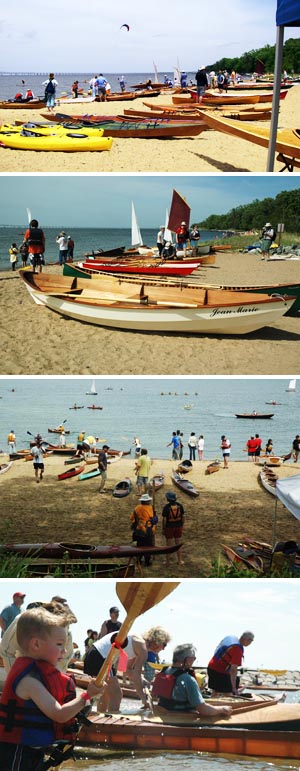
Nothing to do this weekend?  Don't sit around bored.  Come to CLC's spring in the water small craft event.

 
Join us for a fun day on the water!
 
 
The weather forecast is just about perfect for Saturday's on-the-water activities: 70 degrees, some sun, and a moderate breeze from the southeast.  Best of all worlds.

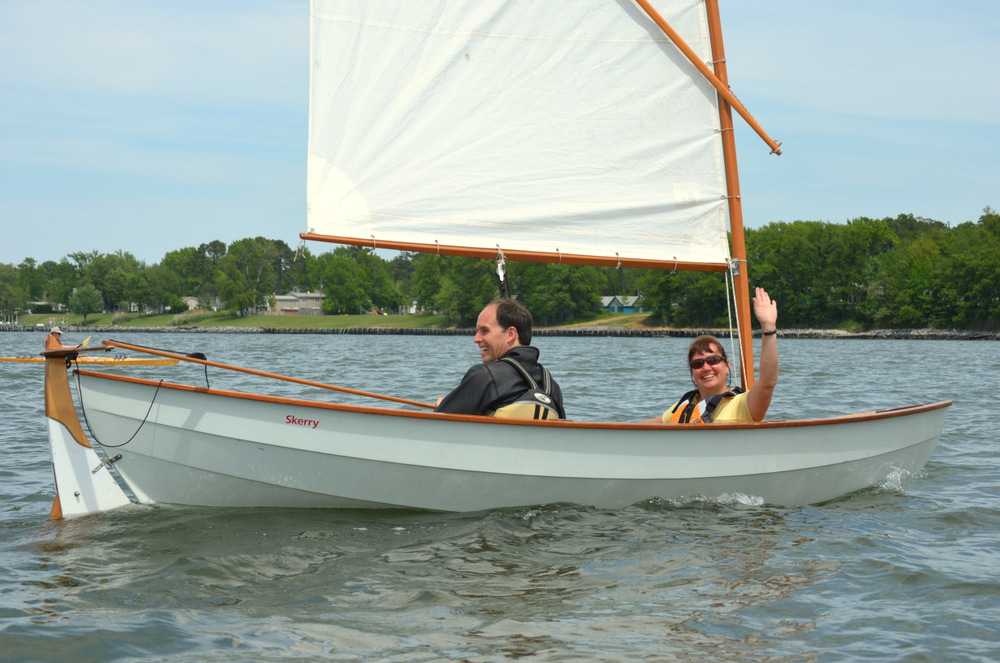
Don't miss this once-a-year opportunity to demo most of the CLC fleet*. Smallcraft like the Skerry (above) are even available for sailing demos.

What's new on the beach for 2013?
 
*Cocktail Class Racers and the Peeler Skiff will not be on the beach, but they will be at our Open House on Friday.
 
Stop by our factory and showroom on Friday between 1pm and 7pm for seminars, tours, and a cookout.  Admission is FREE!


Ed's Once-a-Year Deals
on Kits, Gear, & Supplies
 
Ed's going crazy! Not just CLC caps---he's blowing out E V E R Y T H I N G. Boat kits, random boat parts, finished boats(!), epoxy and fiberglass, paint and varnish, paddles, kayak seats, spray skirts, minicell, safety gear, spruce oars, bronze oarlocks, roof racks, sandpaper, PFDs, PDFs---he can't be stopped.
 
But he'll turn back into a stingy chief operating officer on Monday, so you gotta come to the Friday Open House for the deals!


Cheers,

John C. Harris
Chesapeake Light Craft