Wednesday, September 19, 2012

2012 Classic Moth Boat National Regatta

Unlike last year's chilly affair, this year's edition of the of the CMBA Nats (held over the weekend of 14-16 Sept) offered improvements in both the weather and the turnout of boats.  Last year's event drew 13 Moths, this year 20 boats assembled to race.  In addition to the Classic and Vintage Moths, two of our members also sail International Moths with hydrofoils and they brought them along for demonstrations after Saturday's racing concluded.

Arch Farmer, his brother Larry and grandson Evan stand next to Old 264.  This newly restored boat dates to the early 1930s

At the other end of the spectrum are this pair of hydrofoiling modern Moths.  The hull alone of Old 264 weighs over 150 pounds, the all-up weight of one of the modern boats is 75 lbs!  Photo credit: Amy Smith Linton.
Other boats on the lawn included Gary Gowans' home built Cates-Florida design Gen I Classic (boat with the varnished deck) and Greg Duncan's Skip Etchells designed "Connecticut" Moth (all white boat in background).  The Connecticut was a late 1940s design while the Cates-Florida design dates to the mid  1950s.  The contrasting hull shapes of these two boats offers a nice demonstration of development that occurred during that time span.

Arch Farmer's Dorr Willey-built Moth is another design from the 1940s.  Again, one can appreciate the advancement of hull shapes from the early '30s to the late '40s by studying these two boats.
The Europa design, by Belgian Alois Roland, dates to the early 1960s.  In the late 60s the owners of this Moth design, not liking the developmental aspect of the Moth Class, broke away and formed a strict one-design class around this particular hull shape.  The new class, called the Europe Dinghy was subsequently selected as the women's Olympic single hander and competed in four Olympiads starting with Barcelona in 1992 and ending with the Athens games in 2004.  My boat, Ooh La La, seen here snoozing under her mooring cover was Meg Gaillard's Athens games boat.
Other boats on the lawn included Jeff Linton's Mousetrap.  The Mousetrap design is Jeff's modification of the Mistral Moth to include the Europe dinghy transom  shape.

Jeff's boat features this nifty cassette style rudder.

Another interesting boat is Bill Boyle's Abbott design.  When Bill got this boat she looked like this.

One more look at Old 264.  The Farmer brothers did a wonderful job of bringing this historic boat back from the dead.  In the next post we'll launch boats and go racing.  See you then.

Tuesday, September 4, 2012

Old 264 sails again

Readers may recall that not quite a year ago I posted that I'd given one of the oldest of the known surviving Moth Boats, Nr 264, to brothers Arch and Larry Farmer with the promise of restoration to race worthy condition.  In January I posted a progress report with a few photos of the work done to that point.  Today I'm pleased to post the first photos of Old 264 being given her initial float test which occurred this past Labor Day weekend.  Arch hopes to have his granddaughter Abby sail the boat in the Classic Moth Boat National Regatta which will take place the third weekend of this month.  I can't wait to see the restored boat up close.

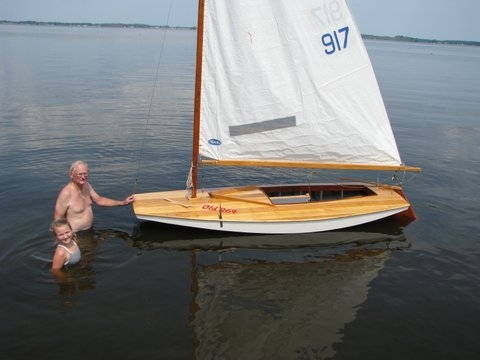
After too many years in storage, Old 264 graces the Pasquotank River near Elizabeth City, North Carolina.

The wind was obviously light to nonexistent that day but it's still wonderful to see the boat back in fighting trim.  The sail (Nr 917) was borrowed for the day from Arch's Dorr Willey-built Moth.

This boat slips along even with the slightest puff of wind.  I'm sure that Joel Van Sant, the founder of the Moth Boat, would approve.

Granddaughter Abby and brother Larry pose with the finished boat.  No doubt she'll be refined and tuned over the next several weeks in anticipation of the regatta.  Wow!  Hopefully this restoration will provide a challenge for the owners of several other ancient Moth Boats to restore their boats and come race.

Friday, August 31, 2012

A day in Gränna and Visingsö

Diaristwoman spent the better part of three weeks back in her old stomping grounds of Jönköping/Huskvarna Sweden.  As can be expected, she took several hundred photos.  Most of those are of her relatives and are interesting to only the family.   However a handfull are general enough to interest a wider audience and I'll share some of those here.  One day diaristwoman, diaristson and diaristmother-in-law took a day off from visiting and headed up the road to the island of Visingsö. More about Visingsö can be read here.

Looking across the rooftops of Gränna (on the mainland) westward to the island of Visingsö which is in the middle of the southern end of Lake Vättern.  After the "grueling" trip of 3 Swedish miles (~30 km) our trio paused for refreshments at Haglunds Konditori--a trip to Gränna/Visingsö without this stop would be unthinkable.

To get over to the island one takes a short ride (less than a half hour) on one of the several small car ferries from the mainland.  My gang generally go as foot passengers and then either rent bikes or tour the island on horse-drawn carriages called "remmalag".

Alternatively, one can book passage on the ångbåt (steamboat) Trafik.  Trafik was built in 1892 and sails from the western shore town of Hjo.  More can be read here.


Approaching the east side of Visingsö one first sees the row of boat sheds used by commercial fishermen.  Peeking up behind those sheds are the buildings where they sell their catch.  The lake is famous for Röding, Sik and Makrill.

The patio of Sol Backen restaurant offers pleasant views of the water and boat traffic.

The ruins of Visingsborg is one of many interesting attractions on the island.  Visingsborg castle was built by Count Per Brahe the younger.  This castle was built in stages between 1573 and 1662.  Per Brahe built a similar castle called Brahe Hus, on the mainland looking towards the island. 

Another interesting historical site is the remains of the fortress of
Näs.  This fortress or slott in Swedish, lies at the southern end of the island.  This fortress has been attributed to Sverker the Elder who reined in the 1100s but most experts agree that it was the seat of Swedish royalty by the early 1200s.

It's hard for photos to convey the thickness of the walls.

There are many other interesting sites and buildings such as the the old Kumlaby and Brahe churches, the Viking era burial mounds, windmills, farms, etc.  Diaristwoman leaves us with this look at a fishing boat departing the safety of the jetty for the open and often tempestuous waters of
Vättern.
 

Saturday, August 25, 2012

Gifts from afar

Diaristwoman has returned from a quick visit to Sweden.  I always weigh her down with a list of goodies to bring back for me.

Is she good to me or what?  None of these items are available in the U.S.  This really is a barbaric country.


Gunnar, I know this is breaking your heart.  If we lived closer together I'd invite you over for a little snort.  This may well be the only bottle of Gammel Dansk in the western hemisphere.  Well, the Danish embassy, downtown, just might have a bottle or two.  But the Ambassador has never invited me over for a drink.  Hey--Mr. Ambassador: are you reading this?  Nudge, nudge, wink, wink... (maybe the guy doesn't like Gammel Dansk--they should recall him).
One can of Arboga (10,2% alcohol) would put you over the limit for driving in Sweden.  The Anderssons is about half the alcohol content but one bottle would still probably be risky if you were driving. Walking is healthy they tell me!
Svenska Nubbar--Swedish "Tacks" as in little nails.  This is an assortment of ten different akvavits from various parts of the country.  Yumm-O!  We'll save this  for Jul.

And of course food for the mind as well as the tongue.

Monday, August 20, 2012

Roadside New Jerseyana; Exhibit 2

Diaristwoman was still back home in the old Country last weekend but that didn't stop your diarist and diaristdaughter from continuing our quest of drinking our way across the "Garden State".  One of the best parts of tracking down vineyards sequestered out in the piney woods and hinterlands is that you drive down small roads you otherwise never would and in doing so you get to see odd and curious things such as a Russian Orthodox Church on a back road near Buena, NJ.

I knew there were Quakers, Free Thinkers, Nudists and even a few Episcopalians hiding out in the piney woods but I'd never have guessed I'd trip across Russian Orthodoxy.  Dig those onion domes.

We were driving along, minding our own GPS lady's commands when the above church complete with iconic onion domes popped out of the woodwork.  I slammed on the brakes and did a double take.  That church would be right at  home on the outskirts of just about any dusty Russian village--but here?  In South Jersey?  I parked the wagon as best I could on the narrow grass shoulder of the country road we were on and took a few pix.  Now most churches have signs proudly indicating the name of the church, the year built, times of services, etc. but not this one.  I looked in vain and found not a clue of its identity. It was very mysterious.  Finding no one to question we eventually moved on.  After all there were wineries to visit and vintages to sample.  I figured I could google it once I was home.  And so I did.  It turns out that this is the Sviato Pokrovskiy (Holy Protection) Russian Orthodox Church and this church is perhaps the final battleground of the Cold War.  It seems that the mother church back in Russia wanted to impose a new prelate, but the parishioners said the new man was ex-KGB and wanted nothing to do with him.  The issue of who owns the church went to court and is apparently a stalemate.  You can read about all that here.  Who knew that the Jersey pine barrens are such a hot bed of international intrigue?  It kind of reminds me of the hoopla surrounding some Episcopal parishes that want to divorce themselves from the main church organization (and retain ownership of valuable historic church buildings) because they don't like the National Church's liberal "all are welcome" stance which awkwardly (for them) includes gay Bishops and female Priests.  The difference of course is that for the Episcopalians this dispute involves Americans whereas with the Russian Orthodox church pictured above there's an international twist to the story.  This all goes to show that a drinking man never knows quite what's just around the corner.

Friday, August 17, 2012

"B" is for Bentley

A while back your diarist attended a British Car show down in Virginia, near Mount Vernon--practically in Geo. Washington's front yard!  I don't think old George would have minded.  What follows are a  few photos of the stand-out cars on display that day.

"B" is for Bentley.  In this case a 4.5 litre Bentley.  No blower, but 007 would still approve.

The Bentley's engine room.  Look at those lovely bronze bodied S.U. carbs.

A rather imposing front view.  Can you image being in a baby Austin of the same vintage and having this sight rapidly filling the rear view mirror?

This car apparently was a Mille Miglia revival entrant back in 2006.


One last look as we move on.  Very proper in BRG.
This T-51 Cooper-Climax next caught my eye.
An ex-Yeoman Credit team car, driven by Tony Brooks, among others during the 1960 season.
Starboard side of the 2.5 litre Climax PFP engine.  It made a most wonderful noise when the owner fired it up at day's end.  He then settled into the cockpit, revved it and popped the all or none clutch for the brief ride back to the transporter.  The car shot off down the bridle trail like a scalded dog.  I'm happy to report that no small children darted into his path.
The T-51's "office".
Yeoman Credit Team logo.  You can read more about this team here.

This nifty little Lotus Elite wasn't on display but merely parked in the spectator's parking area.

The Elite's cockpit.
Note the exposed valve gear on this 3-wheeler Morgan.
One lever on the Moggy's steering wheel is the accelerator while the other is for the spark advance.  I'd sure hate to get 'em confused in the middle of a high speed corner!


Both cars and their occupants were a good bit narrower in those days.

Rover to the rescue!

Every family should have at least one vehicle capable of towing the house off it's foundations.

A very stylish Jaguar SS-100.  This one was once owned by Brooks Stevens.
Port side view of the SS-100's engine.
I'll wrap up this post with one more Jag for the road--an XK-120.  Happy Motoring!