Tuesday, June 12, 2012

A Visit to Le Cirque du Cyclisme XIV


Le Cirque du Cyclisime is an annual multi-day event devoted to steel framed racing and touring bikes from the late 1930s to the mid-1980s.  The 1930s are looked upon as the start of the classic bike period in as much as this time point saw the beginnings of the production of high quality bikes built from lightweight tubing such as the well known Schwinn Paramount.  But one might ask what's so magic about the mid-1980s as a cut off date?  Good question.  One answer is that Tullio Campagnolo, the inventor of many of the components we now take for granted such as the quick release skewer for wheel hubs, died in 1983 and that his passing is a good defining point as the end of the classical period for  hand-built bicycle construction.  After the mid-1980s bicycles moved away from hand-built lugged steel frames and increasing used aluminum, titanium and most recently carbon fiber in a more productionized environment that stresses output rather than craftsmanship.  Of course opinions are divided on this subject but, never the less, there is a large following of enthusiasts who collect and ride the high quality bikes from this era.  They meet annually for this combination bike show/swap meet and to exchange knowledge via seminars devoted to topics such as wheel building, the history of different brands of racing bicycles etc.  There are also group rides through the surrounding countryside for owners who have brought their bikes for display.  Your diarist still didn't have enough grip strength in his right hand to safely ride a bike,and so was content to go on the final day of this year's meet for the Sunday bike show and swap meet.  Let's breathe in Le Cirque's atmosphere.

The day featured temps in the 90s.  Knowledgeable vendors brought tents.  The display area for show bikes is under the big white tent in the background.

There were many bargain bits to haggle over.

These wood rimmed wheels caught your diarist's eye but at $400 were beyond his pocketbook.

Wood rim  maker's decal.  Why am I always drawn to life's high priced items?


Classic Rendezvous web site moderator Dale Brown was working the Cycles de Oro tent.  It was nice to match a face to a name.
Dale Brown

This interesting twin down tube Colnago frame could have been yours for $750.

Several vendors offered vintage wool jerseys.

Nice Mel Pinto handlebar bag on this Jack Taylor bike.

An interesting front fork on this old La France.

I couldn't figure out the make of this bike with the old lamp.  Note the Alex Singer bicycle behind it.  Tasty bikes for sale were stacked up like firewood.

Need a new pair of cycling shoes?  They had 'em priced to sell.

The same money could have bought you this set of wing nuts.

$300 was the asking price for the red Claud Butler frame. Luckily not my size.

Washington , DC based distributor Cycle-Monkey had Rohloff 14 speed hubs on display. 

I don't even want to think about pedaling this bike--look at those tires and imagine the rolling resistance!

I passed on many tempting items but finally succumbed to this pair of sufficiently scruffy Team Raleigh wheel covers bought for the lofty price of $10.  They will look good on the wheels of my ex-Gerri Knetemann Raleigh Team Professional.


There were many other things to drool over in the vendors area but I took several deep breaths and moved on to the display tent.  Unfortunately my camera was misbehaving in macro mode and so my detail photos of the many fine bikes on display are not all that good, but luckily for you many detail pix can be seen here and here.  What follows are a few of my pix that are worth a look.

This Schwinn Paramount is from 1938, the first year of Paramount production.

I liked the twin head lamps on this J.P. Weigle-built bike.

I believe this nice track frame is constructed from stainless steel.  There was no information next to the stand and I couldn't find the owner.

Gunnar, where have I heard this name before?

A nice Masi Gran Criterium..

The same individual had this very nice Colnago Super on display.

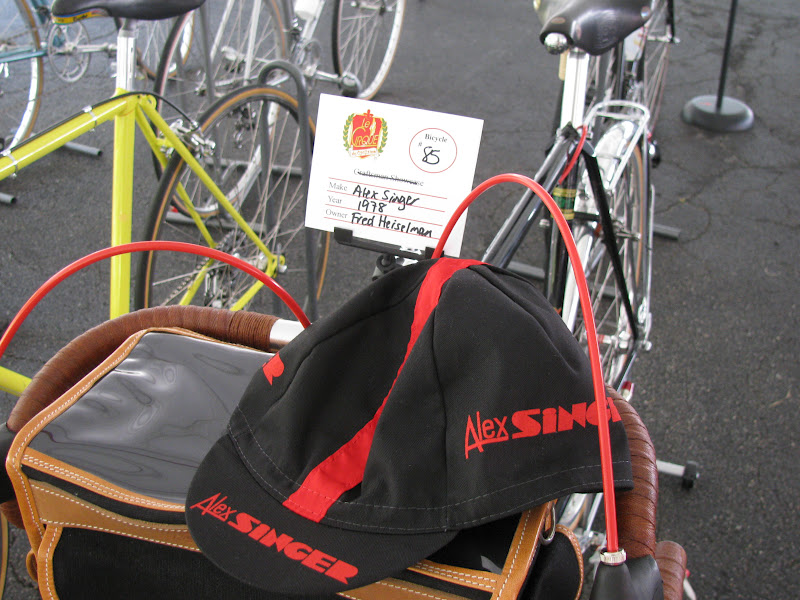
I was taken by this well presented Alex Singer.

Complete with cap--note the absence of panniers; he's ready to go credit card touring--my favorite kind as I'm not much of a camper.

Frame builder Isis Schiffer (works at Bilenky in Philadephia) kindly got this eye catching track bike down from their display so that I could get a decent shot.  She's one of a very few women frame builders in this country.

Another example of Peter Weigle's handiwork.

One of several Chris Kvale bikes on display.

Fork detailing on the Chris Kvale bike.

Towards the end of the day the "keepers of the flame" frame builders where encouraged to gather for a group shot.  I only recognize a few: right side of first row is Peter Weigle; left side of second row is Dale Brown and standing next to him is Isis Schiffer.  The biciak.blogspot.com site has a similar photo with almost complete identities of the folks present.


 The day was growing late and I needed to get home in time for supper.  So I gathered up my wheel covers and walked through the hotel lobby to the car park.  There in the lobby was one last surprise:  this Johnny Coast roadster fitted out for light touring.  I think the mid-50s aluminum bidons complete with their cork stoppers, are a nice departure from the ever present plastic drinking bottles found on most bikes.  Traditionally, they are hung from the handlebars.


Monday, June 4, 2012

A visit to the Cape May Lighthouse

Diarist Familjen took their semi-annual day trip down to Cape May during the past Memorial Day Weekend.  Women were keen on exploring the shoe shopping opportunities afforded by Washington Street.  However when we arrived the public parking lot was chock-a-block full.  This gave your fast thinking old diarist the "out" he was looking for; I dropped them off in the middle of Collier's liquor store parking lot--within walking distance for their shopping safari and then headed down Sunset Blvd. to Cape May Point.  My objective: to take in the views from the top of the Cape May lighthouse.  Care to join me?

The lighthouse, while still maintained by the Coast Guard as an aid to navigation is now owned by the state of New Jersey and is part of a state park.  In turn, the state leases the lighthouse to MAC (Mid-Atlantic Center for the Arts & Humanities).  MAC gets to use the lighthouse for various functions, sell admission tickets, etc. and in turn is responsible for the restoration and upkeep of the structure.  OK, like many good relationships, this one is a little bit complicated...

You know you're in a state park if Smokey the Bear is on duty.

Shoes-Schmoes, this is more like it.  This tower is the third one on this site and it dates to 1859.  The first two, built in 1823 and 1847 were lost to erosion by the ever hungry sea.  The current tower is 157 feet 6 inches tall.

This is the "Oil House".  Back when the lighthouse used oil for the beacon the supplies were kept here.  Now this little building is used to orient visitors.  "Orientation" apparently consists of selling knick-knacks to visiting tourists.  You buy your ticket in the actual lighthouse.

There's 217 steps but who's counting?

The view through this port hole gives a sense of the thickness of the walls as one ascends to the top.

Zooming in on the Cape May-Lewes ferry from one of the port holes.  I blogged about the CM-L ferry in an earlier post.

We're getting near the top.  These stone brackets are flush on the inside of the tower but extend about 5 feet on the outside to support the balcony or "watch gallery" in lighthouse-speak.  You can see them in the photo of the lighthouse earlier in this post.  They're the grey supports just beneath the red platform which forms the watch gallery deck.

Only a few more bloody steps to go until we get to the lantern deck.  Many small children raced by your diarist as he climbed the spiral staircase.  What's the rush?

No more oil lamps.  The current beacon consists of these two 1000 watts lamps. The light is visible for 24 miles.  The beacon rotates every 30 seconds which causes the beam to flash at 15 second intervals.  The original oil beacon had a first order Fresnel lens.

These weird looking cones were all along the outside of the watch gallery.  I had to ask...


They turned out to be ventilators.  This is one viewed from inside the lantern deck.

The thumb screw opens them.  You can see the drain hole in the bottom.  That way rain doesn't accumulate in the vents.  Clever chaps those lighthouse builders.

Here is a view looking north from the watch gallery. One can see the town of Cape May in the upper right. 

This is another one of those World War II fire control towers.  There are several more on the Delaware side of Delaware Bay (I mentioned the Delaware ones in the earlier post about the Cape May-Lewes ferry; see link above).

Twenty five years ago I dug an old Moth Boat, buried in sand, out from under the raised side porch of one of those houses down there.  I can no longer remember which house or the name of the family who sold me the boat.  She was a good boat though and she's still sailing down in Charleston, South Carolina.

The large red roofed building is the old Shoreham Hotel.  It is now St. Mary-by-the-Sea, a retreat for nuns of the Sisters of St. Joseph.  You can read a short history here.  I was told that very few nuns come any more.  For access to beach front property like this I might consider becoming a nun myself.

Back down on the ground I decided to take a peek at the beach.  This state park beach is open for sun bathing and fishing but not for swimming.  The tides and currents at the point are too strong.  It must be a terrible temptation for kids.

Also on the beach at the point is this old bunker from World War II.  Remember the fire control tower?  It directed the cannons which were part of this bunker.  I was all set to explore this when my mobile rang.  It was diaristwoman.  She informed me that money had been satisfactorily spent and that women wanted to be picked up.  And so, dear reader we'll have to explore the bunker on another occasion.

Sunday, June 3, 2012

"Hey Mister--you an artist or somethin'?" A tale wherein your diarist wrestles with his conscience.

I was midway in my journey between Brigantine and Bowie and had stopped for gas at the WaWa store in Middletown, Delaware .  This particular WaWa* is the last convenient oasis for fuel, coffee and a restroom before the road joins the limited access part of route 301 on a southerly path eventually melling with route 50 and the bay bridge some 70 miles later.  I was engrossed with the task at hand and was not being particularly attentive to the other patrons who were also refueling when a voice on the other side of the pumps directed a question at me and the visible cargo I was carrying in the back of my station wagon:  "Hey Mister--you an artist or somethin'?"  What my inquisitor saw through the car windows was a tangle of bayberry limbs that should have been cut into the size required by the City of Brigantine for lawn debris and put out for waste collection along with the smaller branches which I'd generated while pruning the one remaining bayberry in our backyard.  I had to admit, they did look sort of arty laying in the back of the wagon.

* Recall that I mentioned the Wood family from Greenwich in an earlier post.  Richard Wood's descendants started the WaWa chain of convenience stores--small world kinda thing.
Art or lawn debris?

For those not familiar with bayberry it is a wild, native plant which grows on just about all the mid-Atlantic barrier islands.  When I was a boy bayberry bushes covered our entire island from the ocean side to the bay.  Now bayberry is restricted to the dunes and the last handful of undeveloped lots scattered around the island.  Being a sentimental fool, I dug up some small plants a few years ago and transplanted them to our backyard.  Of the several I planted one large one remains along side our back porch.  This plant has grown either into a magnificent specimen (my view) or a large, unruly eye sore (diaristwoman's opinion).  We fight about it each spring.  This year while weeding she found a viney plant which she claimed was poison ivy.  I claimed otherwise but she invoked the safety of small visiting children as an ultimate trump card and so I reluctantly got out the bow saw.  My poor bayberry bush is now a ghost of its former self but at least I was allowed to keep some of the smaller branches of the bush intact with the the edict that I must here after keep up with pruning!  After bundling and moving the twiggy stuff to the alley I was left with a pile of bigger limbs which I decided to bring back to Maryland.

Shaken from my day-dream at the gas pump, I looked up from the nozzle and into the eyes of my inquisitor.  Those who know me well realize that while I, like most humans, respond favorably to art, I myself have little in the way of artistic talent.  Never mind all that, for a microsecond I was greatly tempted to make up a big whopping story about how these crooked, tortured limbs reposing in the station wagon, (sort of like Lenin in his mausoleum), were destined to be "great art" and that he was indeed a lucky man to witness the very beginnings of the artistic process.  After all, I'd probably never see him again.  But then I thought to myself "Devil, if this is the best you can do in the way of temptation then we'll got a very long way to go", and so I told him the truth: "Na, I'm no artist.  I'll sort through this stuff and set aside the few promising pieces and maybe make some tool handles.  The rest will feed the fireplace next winter."  "Tool handles?" he said, obviously disappointed.  "Yeah, you know, handles for files, rasps, chisels, that sort of thing".  He looked away no doubt feeling like he'd wasted his time talking with me and I suddenly realized, much in the same way as a character in one of John Steinbeck's novels, that the truth can at times be a very dangerous commodity--he would have been much happier with a lie--a story that he could tell around his family "campfire" that evening about the crazy artist guy with the weird load of sticks he'd bumped into at WaWa.  My honesty had denied him that small, delicious pleasure.  Our respective nozzles clicked shut, we finished fueling and went our separate ways.


A station wagon load of bayberry limbs reduced to just enough firewood to make a single small fire next winter.


These few sticks might be useful.  We'll see.


I applied a coat of latex paint to the cut ends so that they won't dry out too rapidly and develop checks and splits.  Woodworking supply companies sell expensive sealants for this little job but leftover house paint works well.  I'll let these sticks rest for a few months.  Ya know, just maybe there is some art hiding inside them after all.  I've got a few months to think about it...